
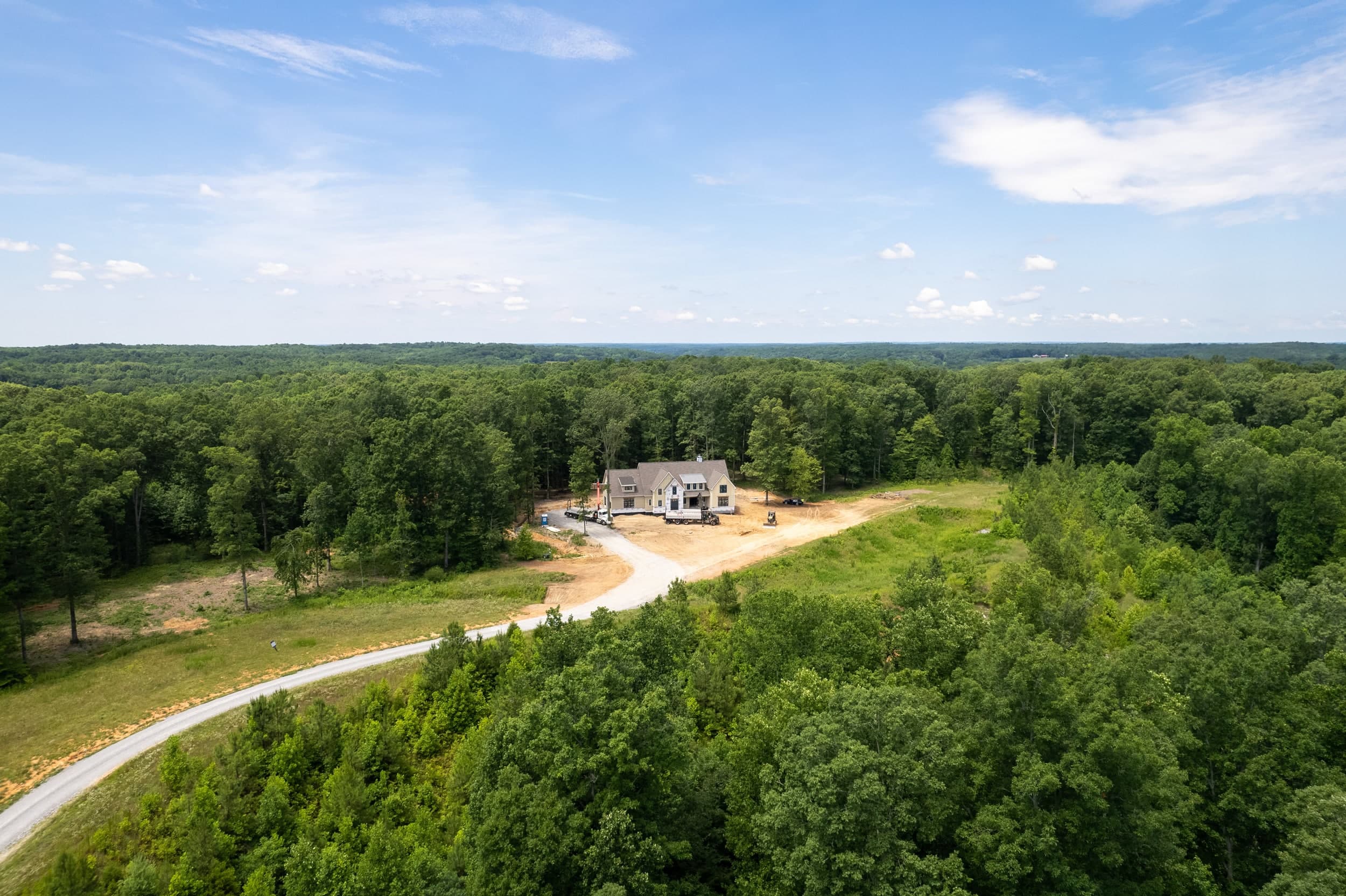
A 0.5-acre lot on a 25% slope in Hamilton County can easily run $40,000 in grading and retaining walls before a foundation is poured. The same-sized lot on a 5% slope might run $6,000. Same county, same builder, same week; the slope is the entire delta. If you're shopping Tennessee hillside parcels, the view is what sells the lot, but the slope percentage is what decides whether the project pencils.
Why Slope Matters More in Tennessee Than You Might Expect
Tennessee averages around 47 inches of rainfall per year, much of it arriving in intense storms. On a flat lot, that water spreads and soaks in. On a slope, it concentrates, accelerates, and strips topsoil. East Tennessee's red clay soil compounds the problem: it expands when saturated, contracts during dry summers, and transmits that movement directly to anything resting on it.
The combination of heavy rain and expansive clay means that sites which might be manageable in a drier state can become genuine engineering problems in Tennessee. Erosion control, drainage, and foundation design are not afterthoughts on a Tennessee hillside; they are load-bearing parts of the project budget.
Slope is measured as a percentage: a 10% slope drops 10 feet for every 100 horizontal feet. Tennessee's septic and building codes use specific slope thresholds as triggers, and understanding those thresholds tells you a great deal about whether a parcel is buildable, expensive, or simply off the table.
Grading and Site Preparation: What It Costs
Site preparation on a sloped Tennessee lot is almost always more expensive than buyers expect. Here is a realistic cost framework:
Flat or gently sloped lots (under 10% slope): Simple regrading to achieve the minimum 5% drainage grade away from a foundation typically costs $4,000 to $11,000 for a quarter-acre building pad.
Moderately sloped lots (10–30%): Cut-and-fill earthwork becomes significant. Excavators move material from the high side of the pad to the low side, or haul it off-site if the soil is unsuitable as fill. Expect $15,000 to $30,000 or more for grading alone, before foundation work begins. Costs rise sharply if rock is encountered: rock excavation adds $40 to $100 per cubic yard on top of standard earthwork rates.
Steep lots (over 30%): Hillside and mountain lots often cost 75% to 200% more to prepare than flat lots. For extreme sites in East Tennessee's ridge country, grading and site work alone can exceed $50,000 before a footing is poured.
Retaining walls: Any significant cut-and-fill usually requires retaining walls. Material and height drive cost dramatically, from $40 per linear foot for smaller segmental block walls to $345 per linear foot for engineered concrete or steel systems. A practical retaining wall project on a residential Tennessee lot typically runs $8,000 to $20,000 installed. In most Tennessee jurisdictions, walls taller than four feet (measured from the bottom of the footing to the top of the wall) require a building permit and a licensed engineer's design.
Drainage systems: French drains, perforated pipe systems, catch basins, and outlet structures are not optional on steep lots. Budget $1,500 to $11,000 for drainage infrastructure, depending on site complexity.
"What's the slope?" is the wrong question because a single average hides the parts that matter. A 12-acre parcel with a 14% mean slope can still have a 5-acre flat shoulder near the road and an unbuildable cliff at the back. LandWise's slope analysis returns the mean, max, and the distribution across three buildability bands (under 15%, 15 to 30%, over 30%), plus the elevation range and an access-viability grade. That tells you whether the buildable footprint exists at all, before you pay for a topographic survey to confirm it.
Foundation Options for Hillside Sites
Choosing the right foundation type is one of the most consequential decisions on a sloped lot. Tennessee builders typically use one of four approaches:
Walkout Basement
The most cost-effective option when the lot drops seven feet or more across the footprint. The slope is graded so that the downhill side of the foundation is fully exposed, creating a full-height wall with windows and doors. That lower level becomes livable space at a fraction of the per-square-foot cost of above-grade construction. A walkout basement typically adds 5% to 10% to a home's resale value. On the right lot, it turns a challenging slope into a genuine asset.
Pier and Beam Foundation
Concrete piers are drilled into stable soil or bedrock, and the structure sits above grade on those piers. This approach minimizes earthwork on very steep sites, reduces the volume of fill needed, and keeps the structure out of contact with Tennessee's moisture-prone soils. Pier and beam systems typically cost $8,000 to $15,000, though driven piling systems for more extreme sites start around $28,000.
Stepped Slab
Rather than pouring a level slab across a slope, the slab steps down the hillside in increments following the grade. This dramatically reduces the volume of fill required and can eliminate the need for tall interior retaining walls. Stepped slabs require skilled formwork and engineering, but they are well-suited to moderate Tennessee slopes where the grade change is consistent.
Caisson and Grade Beam
On rocky East Tennessee ridges where conventional excavation is impractical, caissons are drilled down to bedrock and connected by grade beams that span between them. This system provides a rock-solid foundation but at a cost that reflects the equipment and expertise required. It is the right tool for extreme sites, particularly in the ridge-and-valley geology of Hamilton, Bradley, Polk, and Rhea counties.
Tennessee has adopted the 2018 International Residential Code at the state level. Under IRC Section R403.1.7, any footing on a slope steeper than 33.3% (a 1:3 ratio) must be set back from the slope face according to specific distance formulas that protect against settlement and slope failure. Your structural engineer will calculate the required setbacks for your specific site.
Septic Systems on Steep Slopes: Know the Limits Early
Slope affects more than your foundation and grading budget. It is often the deciding factor in whether a lot can support a septic system at all, and that question can make or break a rural land purchase.
TDEC Rule 0400-48-01 establishes clear thresholds for subsurface sewage disposal systems in Tennessee:
- 0–30% slope: Eligible for a conventional gravity-fed septic system, subject to passing soil and perc evaluations.
- 30–50% slope: A conventional system is not feasible. An alternative system designed by a licensed engineer is required, and an extra-high-intensity soils map must be submitted to TDEC before the site evaluation can proceed.
- Over 50% slope: The site is considered unsuitable for any subsurface sewage disposal system under current TDEC rules.
Even within the 0–30% range, the actual disposal field trenches must be nearly level. Finding a level area large enough for a leach field is often the real constraint on a hillside parcel.
When conventional systems are ruled out, buyers face two primary alternatives:
Mound systems pump effluent into an elevated sand bed that provides the treatment and distribution distance the native soil cannot. Installed cost runs $10,000 to $20,000, plus ongoing maintenance.
Aerobic treatment units (ATUs) provide a higher level of treatment through an oxygen-injected process and are used when mound systems are also not feasible. ATUs cost $10,000 to $25,000 or more installed, plus $75 to $175 per month in operating costs for electricity and required service contracts.
Before making an offer on any sloped Tennessee parcel that is not on public sewer, confirm the slope of the best available septic area on the lot. A soil evaluation runs $500 to $1,500. It is money well spent compared to discovering after closing that the lot cannot support a legal septic system.
Tennessee's Erosion Control Requirements
Any construction project that disturbs one or more acres of land in Tennessee requires coverage under the state's NPDES Construction General Permit (TNR100000), administered by TDEC's Division of Water Resources. Projects disturbing less than one acre may also require coverage if they are part of a larger common plan of development or sale.
To obtain coverage, you must:
- Prepare a Stormwater Pollution Prevention Plan (SWPPP) documenting all erosion and sediment control best management practices before construction begins.
- File a Notice of Intent (NOI) through TDEC's MyTDEC online portal before any clearing or grading starts.
- Implement BMPs consistent with Tennessee's Erosion Prevention and Sediment Control Handbook (the 2026 revised edition became effective January 9, 2026).
Permit fees are scaled by disturbance area: $250 for 1 to 5 acres, $1,000 for 5 to 20 acres.
Many Tennessee cities and counties layer additional local erosion ordinances on top of the state NPDES requirement. Hamilton County, Knox County, and Nashville/Davidson County all have local stormwater programs with their own permit requirements. Check with the local building or stormwater department before breaking ground.
Practical Tips for Buyers Evaluating Sloped Tennessee Parcels
A few things to assess before you make an offer:
- Walk the entire lot. Slope percentages averaged across a parcel can obscure the fact that the buildable area is much steeper than the average.
- Find the flattest area for the septic field first. Your house can go almost anywhere; the septic system has strict slope and soil requirements. Identify the septic area before you commit to a building site.
- Ask about rock. Rocky ridges are common in East Tennessee. A single ledge of bedrock under the building footprint can add tens of thousands of dollars to foundation costs.
- Get a site-specific grading estimate. National cost-per-square-foot estimates are starting points only. A local excavating contractor who has worked in the specific county will give you a far more accurate number.
- Understand drainage patterns. Water from uphill neighbors flows through your lot. Make sure drainage easements and natural drainage channels are accounted for in any site plan.
What we'd actually do first
Walk the lot with a hand-held inclinometer (a phone app works fine) and check the slope at the spot where you'd actually want to build, not the average across the parcel. Then look for a level area at least 50 by 100 feet that's downhill of the building site (for a gravity septic field). If those two areas exist on the parcel and neither is in the 30%+ band, the lot is probably workable. If they don't, the next conversation is with a soils consultant about whether a pump-up or mound system is feasible, and that conversation often ends the project. The $500 to $1,500 soil evaluation is the cheapest way to find out.