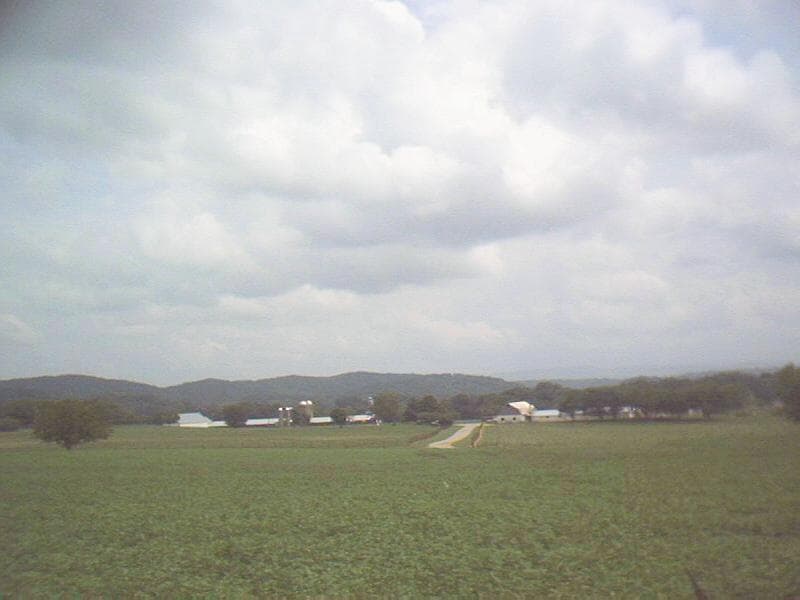

The listing looks perfect: ten acres of East Tennessee hardwoods, a creek running through the back half, listed at $4,500 per acre. Then you pull up the county GIS map and notice something. The parcel shares no edge with any road. Your only way in is across someone else's land, and there's no easement on record.
That's a landlocked parcel, and it's more common in Tennessee than most buyers expect.
Why Landlocked Parcels Are a Tennessee Problem
Tennessee's history of informal land divisions explains most of it. For generations, families split land among heirs with handshake agreements about who would use which path: no recorded easement, no surveyed access route, just an understanding that was clear to everyone involved and invisible to every buyer who came after.
The result shows up in land records across all 95 counties: tracts that were once interior portions of larger farms, now separated and sold independently, with no legal access documented.
Rural Tennessee's topography makes it worse. In ridge-and-valley East Tennessee, on the Cumberland Plateau, and in the Western Highland Rim, road networks follow drainages and ridgelines. A parcel tucked between two ridge faces can be entirely cut off without the owner or the seller realizing it until a title search turns it up.
What Landlocked Status Does to Value
Expect a 40-50% discount compared to similar roadfront land, and that's if a buyer can be found at all. Lenders routinely decline to finance landlocked parcels without documented deeded access, which limits the buyer pool to cash offers from buyers willing to take on the access problem themselves.
The math gets worse when you account for what solving the problem actually costs. A gravel road can run $100,000 or more per mile once you add grading, base material, culverts, and drainage crossings. In East Tennessee's rocky terrain, costs climb higher still.
The Three Legal Routes to Access in Tennessee
If you own or are considering a landlocked parcel, Tennessee law gives you three paths. None of them is quick.
Negotiate an express easement: Reaching a private agreement with the neighboring landowner is the simplest option. It requires their cooperation and fair compensation, but avoids the courts entirely. A clean easement deed, signed and recorded with the county register's office, resolves the problem permanently.
Easement by necessity (common law): If the landlocked parcel and the neighboring land were once under common ownership before being divided, Tennessee courts can recognize an implied easement by necessity. The landlocked owner must prove shared common ownership and that the division created the access problem. This still requires a lawsuit if the neighbor won't cooperate voluntarily.
Statutory condemnation under TCA 54-14-102: This statute gives landlocked owners the right to petition the chancery or circuit court for a condemned right-of-way across a neighbor's land. A 2020 amendment (SB1896) capped the width of a court-awarded easement at 25 feet and authorized courts to award attorney fees to the defending neighbor if the petition isn't well-founded. The petitioner must post a bond equal to twice the appraised value of the land needed and pay compensation to the burdened neighbor. Courts grant this remedy only when no other access exists at all, a limit confirmed in Ben Smith v. White (Tennessee Court of Appeals, January 2024), which also clarified that both the statutory and the common-law paths remain available to landlocked owners.
One firm limit: TCA 54-14-119 bars the court from granting a condemnation easement if the landlocked condition was created by the landlocked owner's own actions. Self-inflicted landlocked status has no statutory remedy.
Between court costs, the appraiser, the bond, and potentially the neighbor's attorney fees, a successful condemnation petition can cost more than the land is worth on a smaller parcel. It's a last resort, not a routine fix.
What to Check Before Making an Offer
Before writing an offer on any rural parcel that looks unusually priced, verify road access independently:
- Pull the county GIS map and trace the parcel boundary. Does it share any edge with a road right-of-way?
- Ask the seller for recorded easement documentation, not just a claim that "there's always been access through the neighbor's property."
- Order a title search, not just a title commitment. A commitment insures against defects; a full search shows what's actually on record.
- Ask your agent specifically whether access is by deed or by permissive use. Permissive access can be revoked at any time.
If you need a connection to a state highway, TDOT requires an entrance permit before any driveway can be constructed. For connections to county roads, the county highway department issues its own permits, and requirements vary by county.
Before ordering surveys and title work, it's worth knowing whether a parcel even touches a road. LandWise reports the distance to the nearest road, whether the parcel boundary contacts a road right-of-way, the road type and surface, frontage details, and whether the parcel shows signs of being landlocked, along with a flag indicating whether an easement investigation is likely warranted. It won't replace a title search, but it surfaces the access question early, before you've spent money on a parcel that may have no viable path in.
For a deeper look at how easements work and how to evaluate recorded access rights, see Tennessee Easements Explained.
The actual picture always requires a licensed surveyor and a title attorney. Knowing a parcel has a road access problem before you make an offer is far better than finding out at closing.