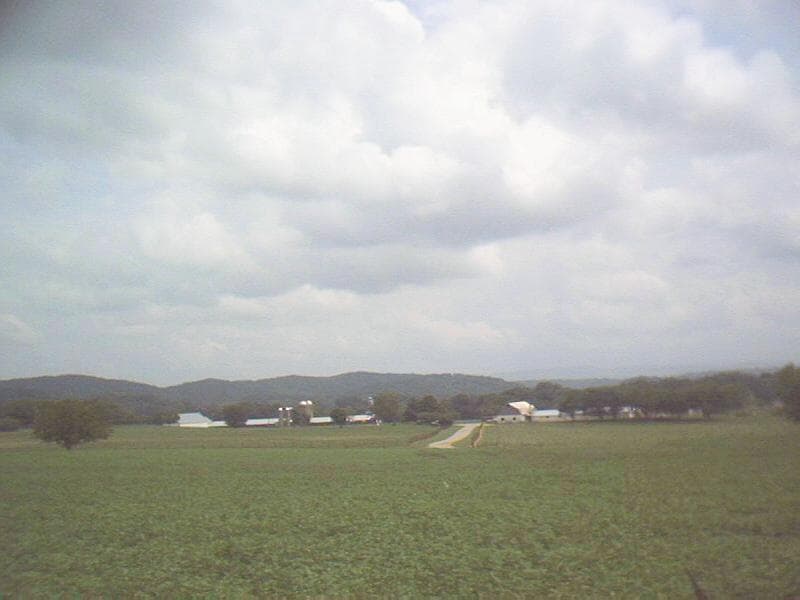

A 50-acre tract enrolled in Tennessee's Greenbelt program can be taxed on 80 to 90 percent less value than the same tract assessed at fair market price. The same parcel, if you buy it and break the agricultural use within three years, owes the county the difference for every one of those years. That swing, often tens of thousands of dollars, is the single biggest tax variable in a Tennessee land deal, and it almost never appears in the listing.
Vacant land carries a different tax profile from a house or a commercial building, and the Greenbelt question sits on top of a county-by-county rate spread that ranges from under 0.50% to over 1.30%. The numbers worth understanding before you close are the ones that compound over a five-year hold.
How Tennessee Calculates Property Taxes
Tennessee uses a three-step formula to calculate your annual tax bill:
- Appraised value: The county assessor determines the fair market value of your parcel.
- Assessed value: A state-mandated assessment ratio is applied to the appraised value. For residential and farm property, that ratio is 25%. Commercial and industrial property is assessed at 40%.
- Tax bill: The assessed value is multiplied by the local tax rate, expressed as dollars per $100 of assessed value.
As a practical example: a 50-acre tract appraised at $200,000 would carry an assessed value of $50,000 (25% of $200,000). At a county tax rate of $2.50 per $100, the annual bill would be $1,250.
Vacant undeveloped land in Tennessee typically falls under the residential classification, meaning the 25% ratio applies. This is good news for buyers, since Tennessee's average effective property tax rate of roughly 0.73% sits well below the national average of about 1.07%.
County Tax Rates Vary Widely
Tennessee does not impose a statewide property tax. Each county and municipality sets its own rate based on budget needs, and the variation across the state's 95 counties is substantial:
- Lower-rate rural counties: Clay and Hancock counties both fall below 0.50%, making them among the most affordable in the state for land holders.
- Mid-range counties: Knox County runs around 0.85%; Williamson County around 0.73%.
- Higher-rate urban counties: Davidson County (Nashville) exceeds 1.20%, and Shelby County reaches approximately 1.34%.
For rural land buyers, this spread matters. A parcel of identical value will cost significantly more to hold annually in a high-rate county than in a low-rate one. Always look up the current tax rate for the specific county before you close.
The Tennessee Comptroller's Office publishes current and historical tax rates for every county on its website, so this research takes only a few minutes.
The Greenbelt Law: A Major Tax Break for Qualifying Land
One of the most impactful tools available to Tennessee landowners is the Agricultural, Forest and Open Space Land Act of 1976, universally known as the Greenbelt Law. Instead of being taxed on market value, land approved under Greenbelt is taxed on its present use value, which is often dramatically lower than what a buyer would pay on the open market.
The savings can be substantial. In practice, Greenbelt classification can reduce a property's taxable value by 80 to 90 percent compared to its full market assessment.
Who Qualifies
The law covers three categories of land:
- Agricultural land: A minimum of 15 acres that is actively farmed. A presumption of farm use applies if the property generates at least $1,500 in average annual gross farm income over any three consecutive years.
- Forest land: A minimum of 15 acres under sustained-yield timber management.
- Open space: A minimum of 3 acres maintained in an open or natural condition for public benefit.
No single owner can enroll more than 3,000 acres per county under the program. Applications must be filed with the county assessor by March 1 of the tax year and must be notarized.
Rollback Taxes: The Hidden Cost of Changing Land Use
The Greenbelt benefit comes with an important obligation. If enrolled land is later converted to a different use, the owner must pay rollback taxes: the difference between what was actually paid under Greenbelt and what full-market taxes would have been, going back:
- 3 years for agricultural and forest land
- 5 years for open space land
This is the trap for buyers purchasing Greenbelt-enrolled land with plans to build or develop. Make sure you account for any rollback liability before closing. Your attorney or the county assessor can calculate the approximate rollback amount based on current records.
Greenbelt eligibility is a judgment call your county assessor makes against state and county rules. LandWise doesn't make that determination, but it surfaces the inputs an assessor or attorney uses: total acreage, soil type and drainage class (SSURGO), the building footprint and tax-record values from existing structures, and the slope distribution that affects whether a tract is realistically farmable or just nominally so. That gives you a defensible starting point for the Greenbelt conversation, not the answer. For more on the soil layer specifically, see our guide on soil types and septic systems in Tennessee.
Reappraisal Cycles: When Your Assessment Changes
County assessors in Tennessee are required to reappraise all property on a cycle of four, five, or six years, depending on the county. The cycle begins with three years of physical inspections (roughly one-third of parcels per year), followed by a full revaluation in the final year.
This means your assessed value and tax bill can shift noticeably when the reappraisal year arrives. Land that has appreciated significantly since the last cycle may see a sharp jump in its tax bill the following year. Buyers purchasing rural land in areas experiencing rapid appreciation should factor this into their carrying-cost projections.
You can find your county's current reappraisal schedule on the Tennessee Comptroller's website.
Appealing Your Assessment
If you believe the assessor has overvalued your property, you have the right to appeal. The process moves through three levels:
- Informal review: Contact your county assessor's office directly. Many counties will review and correct errors without a formal hearing, though this does not preserve your right to further appeal on its own.
- County Board of Equalization: File a formal appeal with the county board. This is the step that preserves your appeal rights for higher review.
- State Board of Equalization: If you disagree with the county board's decision, you may appeal to the state level. State appeals must generally be filed by August 1 of the tax year, or within 45 days of the county board's notice, whichever is later.
For raw land, the most common grounds for an appeal are comparable sales: if similar parcels nearby sold for less than your appraised value, that evidence typically supports a reduction.
What to Check Before You Buy
Before purchasing vacant land in Tennessee, add these tax-related steps to your due diligence checklist:
- Verify the current tax bill: Ask the seller or pull the parcel record from the county assessor's site. Confirm there are no unpaid taxes or delinquencies.
- Check for Greenbelt enrollment: If the property is enrolled, confirm whether you plan to maintain that use or pay rollback taxes as part of the deal.
- Look up the county tax rate: Use the Comptroller's published rate tables to calculate your expected annual bill at current appraised values.
- Ask about the reappraisal cycle: Find out when the county last reappraised and when the next cycle is due. If a reappraisal is imminent and land values have risen sharply, your tax bill may increase soon after purchase.
- Confirm property classification: Make sure the parcel is classified as residential or farm (25% ratio) rather than commercial (40%), which occasionally happens in error.
What we'd actually do first
Pull the current tax record from the county assessor's site and check two boxes before anything else: is the parcel currently in Greenbelt, and when is the next reappraisal? If the parcel is enrolled and you intend to develop, get the rollback estimate from the assessor in writing and treat it as a closing-cost line item. If the next reappraisal is within 12 months and comparable rural sales in the area have moved up sharply, model your carrying cost at the projected new value, not the current bill.
For a parcel you intend to hold and farm or timber, walk through the 15-acre and $1,500-gross-income tests with a Tennessee CPA who handles Greenbelt clients. The application is due to the county assessor by March 1, and the cleanest path is to file the year you close so the lower assessment lands on your first full tax cycle.