Filling a regulated wetland in Alabama without a Section 404 permit exposes the landowner to civil judicial penalties of up to $27,500 per day, and the Corps and EPA routinely catch violations through aerial imagery years after the fact. The cherrybark oak flat behind the back acres that stays wet for two weeks after a heavy rain may be exactly the kind of jurisdictional bottomland hardwood that triggers it.
This guide covers how wetlands are defined in Alabama, which agencies regulate them, what permits you need, and how to identify potential wetlands on a property you are considering.
How Wetlands Are Defined and Regulated in Alabama
Wetlands in Alabama are regulated under federal law, primarily Section 404 of the Clean Water Act, administered by the U.S. Army Corps of Engineers. A parcel qualifies as a regulated wetland only when it meets all three of the following criteria at the same time:
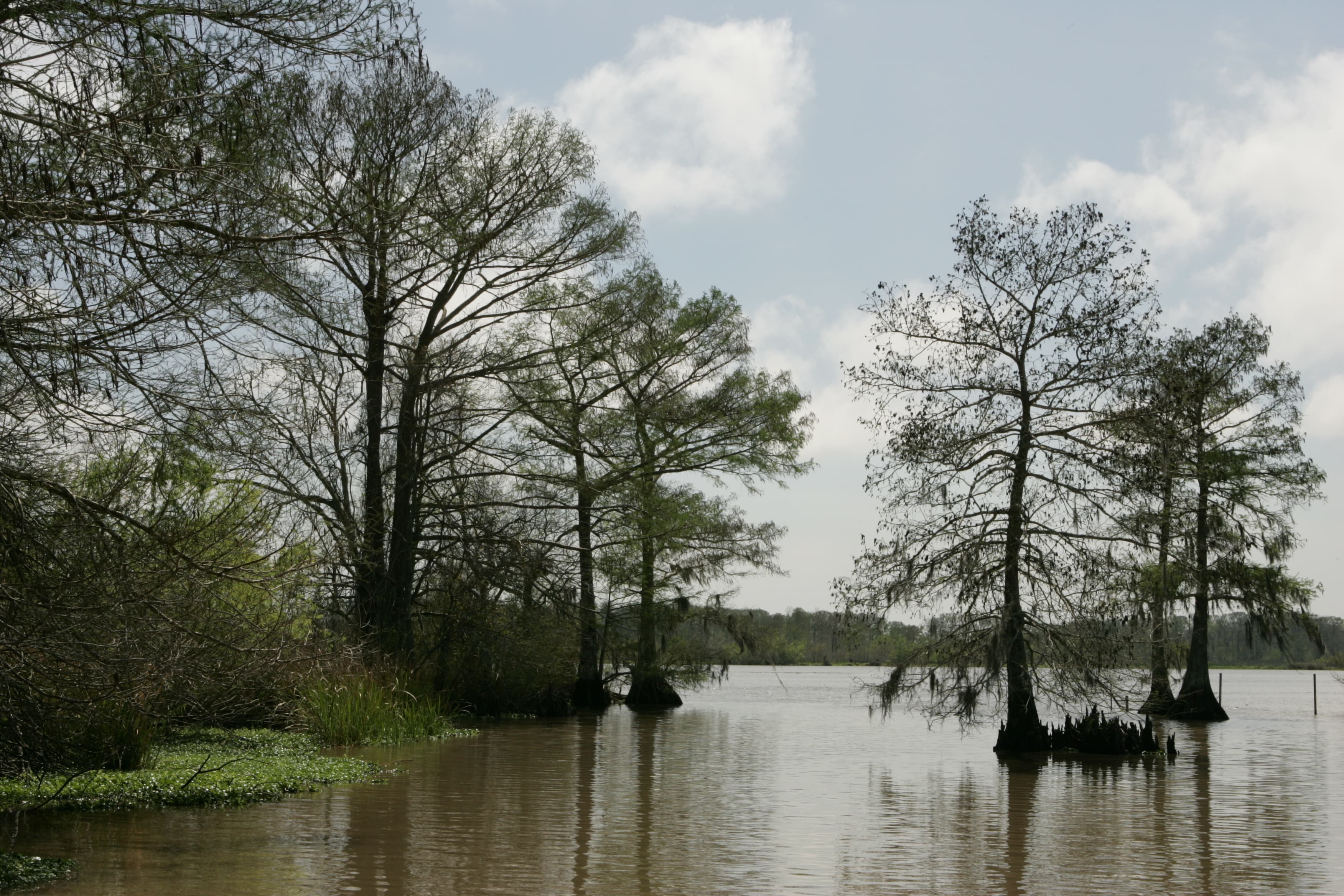
- Hydrophytic vegetation: Plants adapted to grow in saturated soil conditions (e.g., bald cypress, water tupelo, green ash, swamp black gum)
- Hydric soils: Soils that have developed anaerobic (oxygen-depleted) conditions due to prolonged saturation or flooding
- Wetland hydrology: Surface water or groundwater saturation that occurs at a frequency and duration sufficient to support wetland plant life
An area must satisfy all three criteria to be regulated. A boggy low spot with hydric soils but no wetland plants, for example, may not qualify. This is why an on-site delineation by a qualified wetland scientist is the only reliable way to know what you are dealing with.
Which Agencies Regulate Alabama Wetlands?
Two layers of government share authority over wetland development in Alabama:
U.S. Army Corps of Engineers
The Corps administers Section 404 permits for any discharge of dredged or fill material into waters of the United States, which includes wetlands. Alabama is split between two Corps districts:
- Mobile District covers most of Alabama and is the primary contact for buyers in the central and southern part of the state
- Nashville District covers northern Alabama, including Madison County and the Tennessee River watershed
When you plan any grading, fill, or construction that would disturb a wetland, you typically need a Section 404 permit from the relevant Corps district before breaking ground.
ADEM: Alabama's Section 401 Role
The Alabama Department of Environmental Management (ADEM) exercises authority through Section 401 of the Clean Water Act. Before the Corps can issue a Section 404 permit, ADEM must issue a Section 401 Water Quality Certification confirming the project will not violate Alabama water quality standards.
ADEM can grant the certification, attach conditions to it, or deny it outright. A denial from ADEM effectively blocks the federal permit. The two applications are typically submitted together, and ADEM certifications are valid for up to five years.
EPA Region 4
The Environmental Protection Agency's Region 4 office in Atlanta provides oversight and can initiate enforcement actions. The EPA and Corps share enforcement responsibility under Section 404.
Types of Permits and What They Cover
Not every wetland disturbance requires a lengthy individual permit review. The Corps issues three main types:
Nationwide Permits (NWPs): These general permits authorize common, low-impact activities across the country, including residential developments, utility line installation, and road crossings, provided impacts stay below defined thresholds (often 0.1 to 0.5 acres of wetland fill). They are the fastest route for small-scale projects.
Individual Permits: Required for larger or more complex projects. The Corps issues a Joint Public Notice and conducts a more thorough environmental review. These can take many months to process.
General Permits: District-specific permits for minor activities with minimal projected environmental impact.
Whether a nationwide permit applies depends on the type and scale of the activity. Contacting the appropriate Corps district early in your planning process saves considerable time.
What Activities Are Exempt?
Section 404(f) of the Clean Water Act carves out exemptions for certain agricultural and forestry activities on established, ongoing operations. Normal farming practices such as plowing, seeding, cultivating, and harvesting generally do not require Section 404 permits.
The key limitation: the exemption applies only to activities that are part of a farm or forestry operation that was already in place. Converting a wetland to a farm field for the first time is not exempt. Neither is draining or filling a wetland on land you just purchased and intend to clear for development. The "established and ongoing" requirement is strictly interpreted.
Penalties for Unpermitted Wetland Fill
Federal enforcement is serious. Under Section 309 of the Clean Water Act:
- Administrative civil penalties can reach $16,000 per day of violation, with a maximum of $187,500 per enforcement action
- Cases referred to the Department of Justice can result in civil judicial penalties of up to $27,500 per day
- Criminal penalties are available for knowing violations
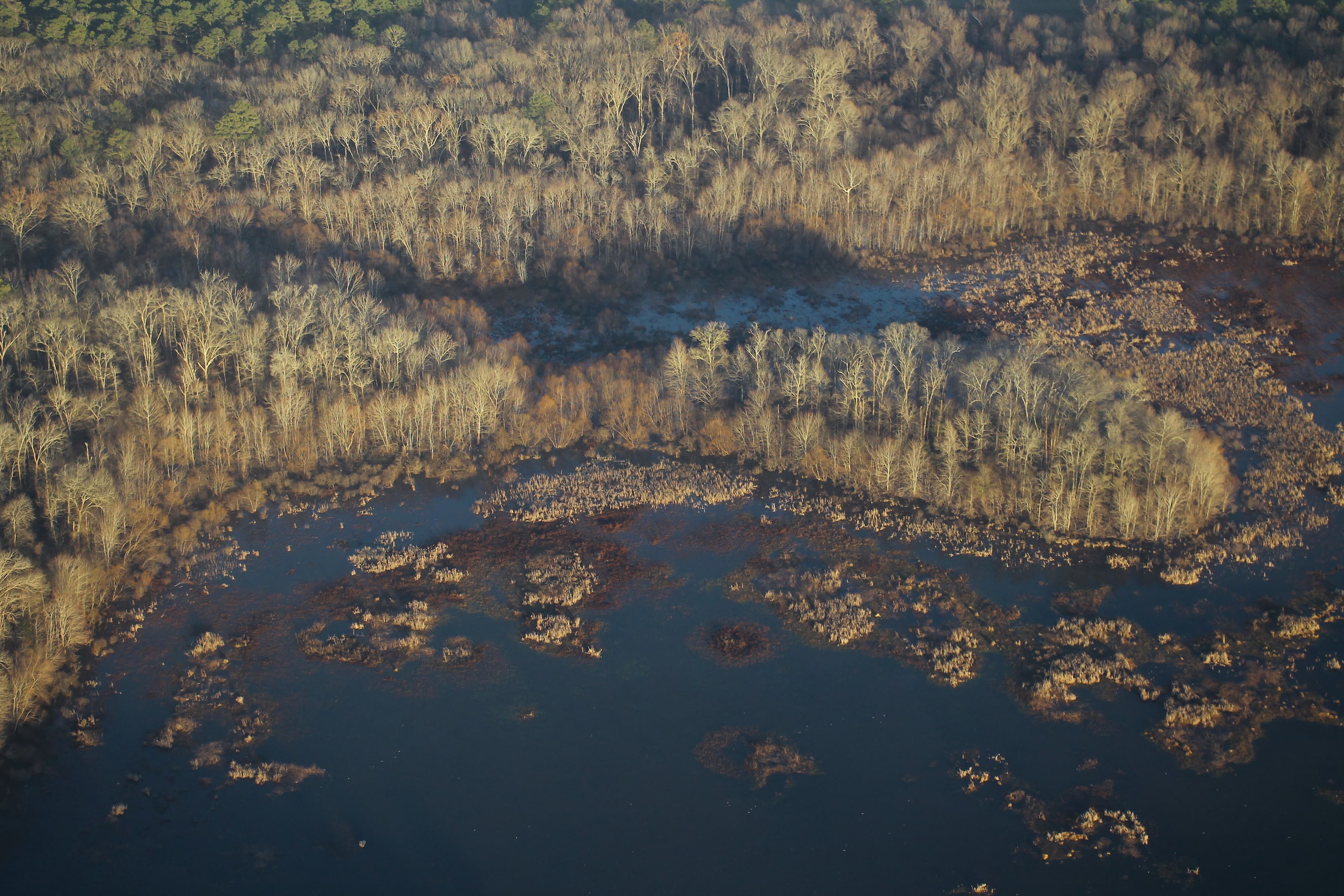
The Corps and EPA regularly investigate unpermitted fill discovered through aerial imagery, complaints, and field inspections. Restoration orders often accompany financial penalties, requiring landowners to physically remove fill material and restore the affected wetland at their own expense. That cost can dwarf the original fine.
Wetlands in Northern Alabama: What Buyers Should Expect
Alabama has some of the most diverse bottomland hardwood wetland systems in the Southeast. In northern Alabama and Madison County specifically, the Tennessee River and its tributaries have shaped extensive riparian wetland corridors. Common wetland types in this region include:
- Bottomland hardwood forests dominated by cherrybark oak, swamp chestnut oak, green ash, sweet gum, and sycamore on elevated stream terraces
- Floodplain swamps with bald cypress, water tupelo, and swamp black gum in the lowest, wettest areas
- Riparian buffers of river birch and sycamore along creek banks
- Isolated depressional wetlands with red maple and green ash in low spots surrounded by uplands
The Wheeler National Wildlife Refuge, located in the Tennessee River valley in Limestone and Morgan Counties adjacent to Madison County, contains tens of thousands of acres of bottomland hardwood and shallow water habitats. Land near any tributary of the Tennessee River in northern Alabama should be evaluated carefully for wetland presence.
How to Identify Potential Wetlands Before You Buy
You do not need to hire a consultant before making an offer, but you should complete a preliminary desktop review first:
USFWS National Wetlands Inventory (NWI) Mapper The free Wetlands Mapper at fws.gov shows mapped wetland polygons across the country. It uses a biological definition of wetlands and is designed for regional analysis, so it will not capture every regulated wetland. But it is a fast way to spot obvious problem areas on a parcel.
NRCS Web Soil Survey The Web Soil Survey at websoilsurvey.nrcs.usda.gov shows hydric soil classifications across Alabama, including Madison County. Hydric soils are one of three required wetland criteria. A parcel with significant hydric soil coverage deserves a closer look.
LandWise Analysis The fear most buyers describe is "the whole back of the parcel is wetland and I won't be able to build." LandWise overlays the USFWS National Wetlands Inventory on the actual parcel boundary and returns the percent coverage, the dominant Cowardin classification (system, class, water regime), and a per-type breakdown, so you can usually see whether the wetland is a 6% riparian strip along a creek or a 60% bottomland forest before you pay $3,500 for a delineation. It is not a substitute for a USACE jurisdictional determination, but it answers the screening question for a few dollars instead of a few thousand. For comparable analysis on the Tennessee side of the river, see wetlands on Tennessee property.
On-Site Delineation If the desktop review raises concerns, hire a qualified wetland scientist or environmental consultant to conduct a formal delineation. They will survey vegetation, soil profiles, and hydrologic indicators and prepare a report documenting where wetland boundaries fall on the parcel. A Corps-accepted delineation report, combined with a jurisdictional determination from the relevant district, gives you legal clarity on what is regulated and what is not.
Delineation costs typically start around $3,500 for a small site and can reach $15,000 to $25,000 for larger or complex parcels.
If Your Property Has Wetlands: What Are Your Options?
Wetlands on a parcel do not necessarily kill a project. Many buyers successfully work with regulated wetlands by:
- Designing around them: Siting structures, driveways, and utilities on upland portions of the parcel
- Using nationwide permits for minor crossings: A driveway or utility line crossing a small wetland may qualify for a nationwide permit with minimal delay
- Purchasing mitigation credits: If fill is unavoidable, you can offset wetland impacts by purchasing credits from an approved mitigation bank. Alabama has multiple active mitigation banks, including the Alabama River Mitigation Bank and Hell's Swamp Mitigation Bank. Market-rate mitigation credit prices in the Southeast generally range from $10,000 to $100,000 per acre depending on wetland type and location.
The NRCS also administers the Wetland Reserve Easement (WRE) program in Alabama, which pays landowners to protect and restore wetlands. For buyers with a conservation focus, this can turn a limitation into a revenue opportunity.
What we'd actually do first
Pull NWI coverage and hydric-soil mapping on the parcel boundary before you go look at it; if more than a quarter of the parcel maps as wetland or the building envelope you want sits in a Cowardin PFO (palustrine forested) polygon, treat the listing as encumbered and renegotiate or walk. If the screening looks workable, write a wetland-delineation contingency into the offer and budget $3,500 to $25,000 for a Corps-accepted delineation report before closing; that document is what gives you legal clarity, not the desktop maps. For parcels in the Tennessee River corridor specifically, our Madison County land buying guide covers the regional pattern.